
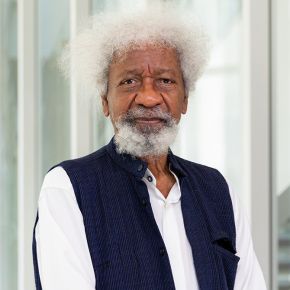
Professor Wole Soyinka is a Nigerian playwright, poet, novelist, essayist and academic whose literary career has spanned more than seven decades. Widely recognised as one of Africa’s most influential writers, Soyinka became the first African laureate to receive the Nobel Prize in Literature, winning the prestigious award in 1986.
Born Akinwande Oluwole Babatunde Soyinka on 13 July 1934 in Abeokuta, Nigeria, Soyinka has built an extraordinary body of work encompassing drama, poetry, fiction, memoir, essays and literary criticism. His writings frequently engage with Nigerian history, African culture, political power, social injustice and the human condition.
Early Life and Education
Soyinka was born into a Yoruba Christian family in Aké, Abeokuta. He was the second of seven children of Samuel Ayodele Soyinka, an Anglican minister and headmaster, and Grace Soyinka, a shopkeeper and activist who came from the Ransome-Kuti family.
His early education began at St. Peter’s Primary School, where his father was headmaster. He subsequently attended Abeokuta Grammar School before proceeding to Government College, Ibadan.
In 1952, Soyinka entered University College Ibadan, where he studied English literature, Greek and Western history. While at university, he began developing his literary voice and wrote his first radio play, Keffi’s Birthday Treat, which was broadcast in 1954.
During his university years, Soyinka also co-founded the National Association of Seadogs, the first confraternity in Nigeria.
In 1954, he moved to England to continue his studies in English literature at the University of Leeds. While at Leeds, he edited the university’s satirical magazine, The Eagle, and continued writing and broadcasting. He also recorded for the BBC and participated in literary and oratory activities.
The Beginning of a Literary Career
After obtaining his degree from Leeds, Soyinka began establishing himself as a playwright and writer in Britain.
In 1957, he began work on two of his early plays, The Swamp Dwellers and The Lion and the Jewel. He later worked as a play reader at London’s Royal Court Theatre, where his play The Invention was produced in 1957.
Soyinka returned to Nigeria in 1959 after receiving a Rockefeller Research Fellowship to study African theatre. He became increasingly involved in Nigeria’s emerging theatre and literary scene, producing plays and establishing theatrical groups.
In 1960, he formed the 1960 Masks theatre group, while his play A Dance of the Forests was selected as the official play for Nigeria’s independence celebrations. It premiered in Lagos on 1 October 1960.
His early works established themes that would continue throughout his career, including political power, corruption, social hypocrisy, tradition and the tensions created by colonial and post-colonial societies.
Literature and Social Engagement
Soyinka’s writing has consistently been closely connected to Nigeria’s social and political realities.
His works include celebrated plays such as The Trials of Brother Jero, Kongi’s Harvest, The Road, Death and the King’s Horseman and The Lion and the Jewel.
His literary output also includes novels such as The Interpreters, Season of Anomy and Chronicles from the Land of the Happiest People on Earth, as well as poetry collections, essays and memoirs.
According to the supplied biographical record, his body of work includes three novels, ten collections of short stories, seven poetry collections, twenty-five plays and five memoirs, alongside translated works and numerous articles and short stories.
Imprisonment During the Nigerian Civil War
Soyinka’s commitment to political and social issues extended beyond his writing.
Following the military coup of January 1966 and the growing tensions that eventually led to the Nigerian Civil War, he became involved in efforts to prevent the conflict.
He secretly met with political and military figures in an attempt to communicate between opposing sides. Following the Biafran invasion of the Midwest region, Soyinka was accused by the Nigerian government of being a traitor and was arrested.
He spent approximately 22 months in detention without trial. During his imprisonment, he continued writing, producing poems and notes that criticised the Nigerian government and reflected on his experiences of confinement.
His prison experience later became the basis for The Man Died: Prison Notes, one of his major autobiographical works.
After his release in 1969, Soyinka returned to literary and academic work, producing plays, poetry and essays while continuing his engagement with Nigeria’s political and cultural affairs.
Academic Career
Alongside his literary career, Soyinka has had a distinguished academic career.
He served as Professor of Comparative Literature at Obafemi Awolowo University from 1975 to 1999. His academic career also took him to several leading universities around the world.
In the United States, he taught at Cornell University, where he served as Goldwin Smith Professor for African Studies and Theatre Arts. He was later appointed Robert W. Woodruff Professor of the Arts at Emory University.
He has also taught or held academic appointments and visiting positions at institutions including the universities of Cambridge, Oxford, Harvard and Yale, as well as New York University and other institutions.
In September 2022, Soyinka took up an appointment as Professor of Theatre at New York University Abu Dhabi.
Winning the Nobel Prize in Literature
The defining international milestone of Soyinka’s career came in 1986, when he was awarded the Nobel Prize in Literature.
He became the first African laureate to receive the Nobel Prize in Literature. The Nobel committee recognised his ability to bring a wide cultural perspective and poetic dimensions to the drama of human existence.
His Nobel acceptance speech, titled “This Past Must Address Its Present,” addressed the struggle against apartheid in South Africa and was devoted in part to the cause of South African freedom fighter Nelson Mandela.
The award established Soyinka as a major figure in world literature and further brought African literary traditions and political experiences to international audiences.
A Voice on Politics, Culture and Human Rights
Soyinka’s public life has extended well beyond literature.
Throughout different periods of Nigeria’s political history, he has spoken publicly about government, military rule, corruption, human rights, freedom of expression and social justice.
In 1994, he was appointed a UNESCO Goodwill Ambassador for the promotion of African culture, human rights, freedom of expression, media and communication.
He has also received international recognition for his advocacy of freedom of thought and expression. In 2014, he received the International Humanist Award after delivering a speech titled From Chibok with Love at the World Humanist Congress in Oxford.
His political interventions have sometimes attracted controversy, reflecting the outspoken nature of his public commentary.
Later Literary Work
Even after decades of international recognition, Soyinka continued to produce new literary work.
In 2021, he published Chronicles from the Land of the Happiest People on Earth, his first novel in almost five decades. The novel examines power, corruption and political life in Nigeria through satire and a crime narrative.
His work has also continued to reach audiences beyond literature. In 2022, a film adaptation of his play Death and the King’s Horseman, titled Elesin Oba: The King’s Horseman, premiered at the Toronto International Film Festival. The production was co-produced by Netflix and EbonyLife TV.
Two films have also explored aspects of Soyinka’s life and legacy, including The Man Died, based on his prison memoir, and Ebrohimie Road, which examines the Ibadan home where he lived during an important period of his academic and literary career.
Books and Major Works
Soyinka’s literary catalogue includes works across drama, poetry, fiction, memoir and essays.
Among his notable works are:
- The Swamp Dwellers
- The Lion and the Jewel
- The Trials of Brother Jero
- A Dance of the Forests
- Kongi’s Harvest
- The Road
- The Interpreters
- Season of Anomy
- Death and the King’s Horseman
- The Man Died
- Aké: The Years of Childhood
- You Must Set Forth at Dawn
- Chronicles from the Land of the Happiest People on Earth
His literary works frequently draw upon Yoruba mythology, African traditions and contemporary political realities, creating a distinctive body of writing that connects African cultural experience with universal questions about power, identity, morality and human existence.
Honours and Recognition
Over the course of his career, Soyinka has received numerous national and international honours.
Among them are:
- Nobel Prize in Literature — 1986
- John Whiting Award
- Anisfield-Wolf Book Award
- Commander of the Order of the Federal Republic
- Mondello Prize Special Jury Prize
- Europe Theatre Prize Special Prize — 2017
- International Humanist Award — 2014
- Golden Plate Award from the American Academy of Achievement
- Haydée Santamaría Medal from the President of Cuba — 2024
He has also received honorary academic degrees and traditional Yoruba titles during his career.
In 2018, the University of Ibadan renamed its arts theatre the Wole Soyinka Theatre. In 2025, Nigeria’s National Theatre was renamed the Wole Soyinka Centre for Culture and Creative Arts.
Legacy
Wole Soyinka’s influence extends across literature, theatre, academia and public life.
The Wole Soyinka Annual Lecture Series, established in 1994, was created to honour his contribution to Nigerian and African literature. A writers’ enclave was also established in his honour at the African Heritage Research Library and Cultural Centre in Ibadan.
His writings have become part of the international study of African literature, while his plays continue to be performed and adapted for new audiences.
For generations of Nigerian and African writers, Soyinka has represented a model of literary independence and intellectual engagement. His career demonstrates how literature can operate not only as an artistic medium but also as a means of examining society, confronting political power and preserving cultural memory.
Wole Soyinka Today
More than seven decades after he began publishing and producing literary works, Professor Wole Soyinka remains one of Nigeria’s most internationally recognised writers.
His career has crossed continents and disciplines—from the theatres of London and Lagos to universities in Africa, Europe, the United States and the Middle East. His writing has addressed Nigeria’s history and political realities while drawing extensively from Yoruba culture, mythology and the wider African experience.
From his childhood in Abeokuta and education in Ibadan and Leeds, to his imprisonment during the Nigerian Civil War and his historic Nobel Prize, Soyinka’s life has been inseparable from the intellectual, cultural and political history of modern Nigeria.
As a playwright, poet, novelist, scholar and public intellectual, Wole Soyinka has created a body of work that has carried Nigerian and African experiences onto the world literary stage. His Nobel Prize may stand as the most internationally visible recognition of his career, but his enduring legacy is found in the works, ideas and cultural conversations that continue to emerge from his extraordinary body of work.