
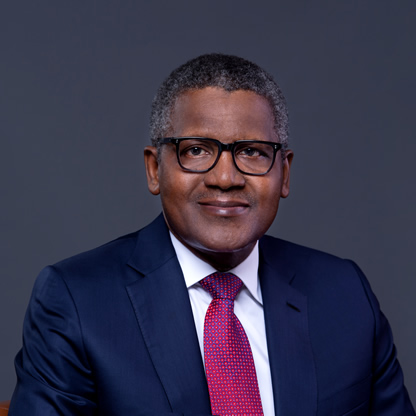
Aliko Dangote is a Nigerian industrialist, investor and philanthropist best known as the founder of Dangote Group, one of Africa’s largest diversified business conglomerates. His business interests span cement manufacturing, sugar refining, food processing and oil refining, with operations and investments extending across several African countries.
Born Aliko Mohammad Dangote on 10 April 1957 in Kano, Nigeria, he began his business career trading commodities before building an industrial group with a substantial presence in essential consumer goods and infrastructure-related industries.
Over several decades, Dangote has become one of Africa’s most prominent business figures, associated with efforts to expand domestic manufacturing, reduce dependence on imported products and develop large-scale industrial capacity across the continent.
Early Life and Family Background
Dangote was born into a prominent business family in Kano State, northern Nigeria. He is of Hausa descent and grew up in a Muslim household.
His mother, Mariya Dantata, was a businesswoman and philanthropist, while his father, Mohammed Dangote, was involved in business and transport.
His maternal great-grandfather, Alhassan Abdullahi Dantata, was a prominent merchant who traded kola nuts and exported groundnuts. Dantata was regarded as one of the wealthiest businessmen in West Africa during his lifetime.
Dangote’s family background exposed him to commerce and enterprise from an early age. He has also identified his maternal grandfather, Sanusi Dantata, and his maternal uncle, Usman Amaka Dantata, as influential figures during his upbringing.
Following the death of his father in 1965, Dangote was raised with support from his extended family.
Education
Dangote received his early education in Kano, attending Sheikh Ali Kumasi Madrasa before completing his primary and secondary education.
He attended Capital High School in Kano and later Government College, Birnin Kudu, where he completed his secondary education in 1978.
Afterwards, he travelled to Egypt to study at Al-Azhar University in Cairo, where he earned a bachelor’s degree in business studies and administration.
His education provided a foundation in business and administration, while his exposure to commercial activity through his family helped shape his interest in entrepreneurship.
Starting a Business With a Loan
Dangote began his entrepreneurial journey in 1977, initially trading commodities such as sugar, salt and other food products.
According to accounts of his early career, he started his business with a loan of approximately $3,000 from his uncle.
His first activities centred on importing and distributing essential goods in Nigeria, a market where demand for food products and construction materials created opportunities for traders and distributors.
Rather than remaining solely in commodity trading, Dangote gradually expanded his business interests into importing cement and other materials. He also established a fleet of trucks to support the transportation and distribution of goods.
This combination of trading, logistics and distribution helped lay the foundation for the expansion of his business into manufacturing.
The Growth of Dangote Group
Founded in 1977, Dangote Group evolved from a commodity-trading business into a diversified industrial conglomerate.
During the early 1980s, the business expanded into products and sectors including rice, steel, aluminium, textiles, sugar, flour and other commodities.
Over time, Dangote increasingly focused on manufacturing and industrial production rather than relying exclusively on imported goods.
This strategic shift became a defining feature of the group’s development. By investing in local production capacity, the business sought to serve Nigeria’s large domestic market while building industrial operations capable of supplying customers across Africa.
Today, Dangote Group is associated with major investments in cement, sugar, food processing and petroleum refining.
Building a Cement Manufacturing Business
Cement became one of the central pillars of Dangote’s industrial strategy.
After initially participating in cement imports and distribution, Dangote expanded into domestic production, establishing a manufacturing business that would grow into Dangote Cement.
The company’s development included investments in large-scale cement plants, including its facility in Obajana, Kogi State, which the supplied source identifies as the largest cement plant in sub-Saharan Africa.
Dangote Cement also expanded beyond Nigeria. In South Africa, the company entered a joint venture with Sephaku Holdings to develop and operate cement manufacturing operations. Dangote Cement holds a 64 per cent interest in the project, according to the supplied source.
The expansion of the cement business reflects Dangote’s broader industrial approach: investing in production capacity to serve infrastructure and construction markets across the continent.
Expanding Into Sugar and Food Manufacturing
Another major part of Dangote Group’s business is sugar refining.
Through Dangote Sugar Refinery, the group established a significant presence in Nigeria’s sugar industry, supplying a commodity widely used by households and manufacturers.
The group also developed interests in flour, pasta, salt and other food-related products.
These investments place Dangote Group within industries that supply essential goods to large consumer markets. They also reflect a business strategy built around products with sustained demand from households, retailers and industrial customers.
By expanding domestic processing and manufacturing, the group has sought to strengthen local production and supply chains.
Launching Africa’s Largest Oil Refinery
One of Dangote’s most ambitious industrial projects has been the Dangote Petroleum Refinery, located in the Lekki area of Lagos State.
Commissioned in 2023, the refinery was designed to process crude oil into refined petroleum products for the Nigerian market and international customers.
The project represents a major expansion of Dangote’s business interests into the energy sector and has been widely regarded as one of Africa’s most significant private industrial investments.
Its development reflects Dangote’s longstanding emphasis on building large-scale domestic production capacity in industries where African countries have historically depended heavily on imports.
The refinery’s operations have also generated debate about market competition, fuel pricing and the concentration of influence within Nigeria’s petroleum supply chain.
Nevertheless, the project has become a central part of Dangote’s industrial portfolio and his ambition to develop manufacturing infrastructure at continental scale.
Expanding Across Africa
Although Nigeria remains the core of Dangote Group’s operations, the company has developed business interests in several other African countries.
Its investments include cement manufacturing in South Africa and Benin, as well as commercial activities involving cement and other commodities in Ghana.
These operations form part of a wider strategy to serve African markets through regional production and distribution.
In May 2025, a company backed by Dangote was reported to have acquired Pollman’s Tours and Safaris, one of Kenya’s established tourism businesses, for approximately KSh4 billion.
In September 2026, Dangote announced funding for a fuel pipeline and storage project connecting Dewele in Ethiopia with Damerjog Port in Djibouti. The proposed infrastructure is intended to strengthen regional fuel transportation and storage capacity.
These investments illustrate the geographic reach of his business interests beyond Nigeria’s borders.
Leadership and Public Policy Engagement
Dangote’s business activities have also intersected with public policy and national economic management.
In 2011, President Goodluck Jonathan appointed him to Nigeria’s Economic Management Team.
He was also associated with political fundraising and advisory activities, including support for Olusegun Obasanjo’s re-election campaign in 2003. He was later named as an adviser to President Muhammadu Buhari’s 2019 re-election campaign.
In 2016, the United States Chamber of Commerce appointed Dangote co-chair of its US-Africa Business Center, a platform focused on commercial relations between the United States and African markets.
In 2022, President Muhammadu Buhari appointed him chairman of the Nigeria End Malaria Council, reflecting his involvement in public health initiatives alongside his business activities.
Philanthropy and Social Investment
Dangote has supported charitable and humanitarian initiatives through personal donations and the Aliko Dangote Foundation.
His philanthropic activities have included contributions to public health, education and humanitarian relief.
In 2014, he donated ₦150 million to support efforts to combat the Ebola outbreak in Nigeria.
In 2016, he pledged $10 million to assist Nigerians affected by the Boko Haram insurgency.
In 2020, he donated ₦200 million to support the response to the COVID-19 pandemic.
His foundation has also supported social and development initiatives, including programmes addressing health and education challenges.
These activities have formed an important part of his public profile beyond industrial investment and corporate leadership.
Wealth and Business Influence
Dangote has been a fixture on international billionaire rankings for years, with his wealth linked primarily to his interests in cement, sugar and petroleum refining.
He first appeared on the Forbes Billionaires List in 2008. His estimated net worth has fluctuated over time with market conditions, currency movements and changes in the valuation of his business holdings.
The supplied source gives differing estimates from Forbes and Bloomberg for September 2026. These figures should be treated as separate estimates rather than combined into a single valuation, because the publications use different methodologies and may report at different times.
His position in the African business landscape reflects both the scale of his industrial holdings and the importance of cement, food processing and energy to the continent’s economic development.
Criticism and Debate Over Market Influence
Dangote’s business success has also attracted criticism and debate.
Commentators have questioned the degree of market concentration in industries where his companies hold significant positions, particularly cement, sugar and petroleum refining.
The refinery, in particular, has prompted discussion about competition, pricing and the relationship between large private investments and government policy.
Some critics have also raised questions about whether the group’s scale and access to public institutions create advantages over smaller competitors. Dangote has disputed allegations of preferential treatment reported in connection with his business dealings.
These debates form part of a broader discussion about industrial policy, competition and the role of large conglomerates in developing economies.
Awards and International Recognition
Dangote has received numerous awards and honours for his business achievements, philanthropy and influence.
His recognitions include:
- Grand Commander of the Order of the Niger (GCON) in 2011, conferred by President Goodluck Jonathan.
- Ernst & Young Entrepreneur of the Year Award in 2012.
- Inclusion in TIME magazine’s 100 Most Influential People in the World in 2014.
- Recognition as The Guardian‘s Man of the Year for 2015.
- Inclusion among influential African business figures by New African magazine.
- The Nigeria Employers’ Consultative Association Lifetime Achievement Award, which he received in 2021 and again in 2023, according to the supplied source.
- The National Order of the Lion of Senegal in 2024.
- The Order of Merit of Niger in 2022.
- Recognition as CEO of the Year by Economic Confidential in 2024.
- The Sabistation Business Owners Award in 2024.
These honours reflect his standing in African business and the international recognition of his industrial and philanthropic activities.
Legacy: Building Industrial Capacity in Africa
Aliko Dangote’s business career illustrates the transition from commodity trading to large-scale manufacturing and industrial investment.
Starting with a relatively small trading operation, he developed a business group with interests in cement, sugar, food products and petroleum refining. His companies have invested in manufacturing facilities and distribution networks serving Nigeria and other African markets.
His emphasis on local production has contributed to discussions about import substitution, industrialisation and the development of African supply chains.
At the same time, the scale of his businesses has raised important questions about competition, market concentration and how governments should balance support for major industrial investments with the need for competitive markets.
His career therefore represents both the opportunities and the complexities of building large private-sector enterprises in emerging economies.
Aliko Dangote Today
Aliko Dangote remains one of Africa’s best-known industrialists, with business interests spanning essential consumer goods, construction materials and energy.
From the establishment of Dangote Group in 1977 to the development of major cement and sugar operations and the commissioning of his petroleum refinery, his career has been defined by a long-term focus on building industrial capacity.
Through his business ventures and philanthropic activities, Dangote continues to influence conversations about manufacturing, infrastructure, public health and economic development across Africa.
His story is that of a commodity trader who built a major industrial group—and whose expanding investments reflect the ambitions, opportunities and challenges of Africa’s evolving economy.